There’s always that one spot.
The stretch of yard you mow but never sit in. The awkward corner that collects leaves. The space behind the house that technically exists — but doesn’t actually function.
We had one too.
For years, we walked past it without seeing it. It wasn’t broken. It just wasn’t anything.
And that was the problem.
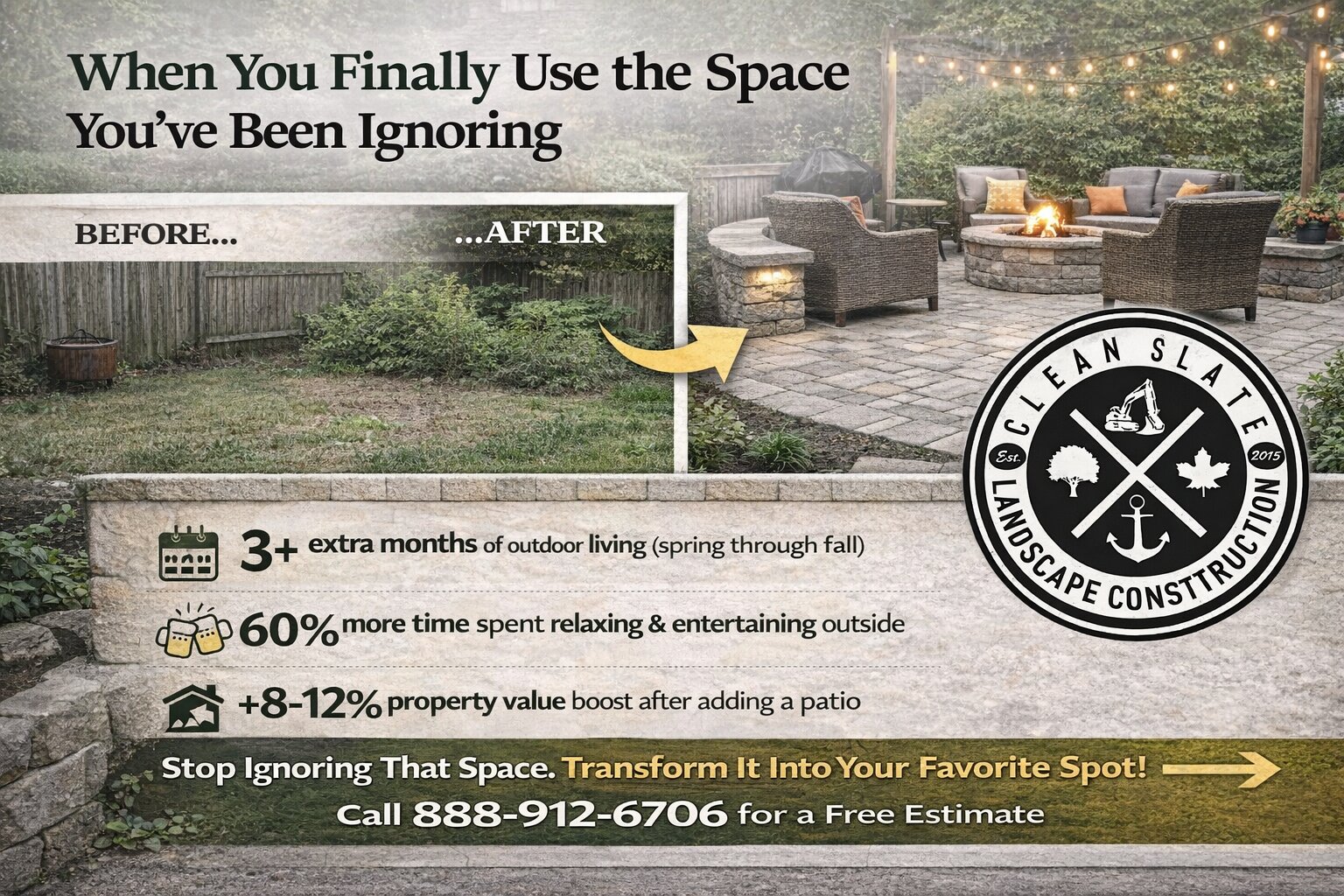
Within weeks of committing to a real patio installation, that “nothing” space became the most used part of our home. Not because it looked fancy — but because it finally worked.
The Space We Pretended Didn’t Bother Us
We told ourselves it was fine.
“We don’t entertain that much.”
“The deck is enough.”
“We’ll deal with it next year.”
But every time we hosted, we dragged chairs across uneven grass. Every time we stepped outside after dinner, we lasted five minutes before heading back in.
The yard wasn’t inviting. It was undefined.
And undefined space creates hesitation. You don’t fully relax in it. You don’t plan around it. You don’t live in it.
You tolerate it.
Dead Space Shrinks Your Lifestyle
Here’s the part most people don’t say out loud:
Unused space makes your home feel smaller — even if it isn’t.
We weren’t short on square footage. We were short on usable square footage.
The backyard looked decent from the window. But from ground level? It was sloped in weird spots. Soft in others. No clear seating area. No anchor point.
So what happened?
- We defaulted to staying inside.
- The kids didn’t play out there long.
- We hosted less often than we wanted to.
- Even quiet mornings outside felt inconvenient.
When a space requires effort to use, you slowly stop using it.
The Turning Point Wasn’t Dramatic
It wasn’t some HGTV-inspired epiphany.
It was a small, slightly embarrassing moment.
We had neighbors over. Drinks were balancing on a wobbly folding table. Someone stepped in a divot and stumbled. The grill felt disconnected from where people were sitting.
The whole night felt… improvised.
After everyone left, we looked at each other and said, “Why are we still doing this?”
That’s when we stopped talking about patching grass and started talking about actually redesigning the space.
The Difference Between “Adding Stone” and Creating Flow
This is important.
We didn’t just want hardscape. We wanted purpose.
When the team walked us through layout options, elevation adjustments, drainage considerations, and how seating areas could connect naturally to the house, something clicked.
This wasn’t about stone color.
It was about flow.
Where do people enter the yard?
Where does conversation naturally happen?
Where does the sun hit at 6 p.m.?
How does it feel walking from inside to outside?
That level of thought changes everything.
A proper patio installation isn’t just surface work. It’s spatial design. And once it’s done right, the difference is immediate.
What Changed After It Was Finished
The first morning after completion, we drank coffee outside.
Not because we forced ourselves to — but because it felt obvious.
There was a defined space. Level seating. Room to breathe. A layout that made sense.
Within a month:
- We ate dinner outside multiple nights a week.
- The kids brought friends over and actually used the backyard.
- We hosted without rearranging furniture.
- We spent more time together without screens.
It didn’t feel like a renovation.
It felt like we unlocked part of the house that had been sitting dormant.
It Impacts More Than You Think
Here’s the honest part.
It’s not just about entertaining.
It’s about daily life.
When your outdoor space is intentional:
- You decompress outside instead of pacing inside.
- You step into fresh air without it feeling like a project.
- You actually use your property — not just maintain it.
There’s a quiet pride in that.
And in a place like Cape Cod, where outdoor living is part of the lifestyle, having a functional space isn’t a luxury. It’s how you fully experience your home.
“But Is It Worth It?”
That was our biggest hesitation.
It felt like a big decision. A real investment.
But here’s the shift in perspective:
We weren’t paying for stone.
We were paying for daily use.
If you break it down over years of dinners, gatherings, coffee mornings, quiet evenings, and everyday life — it’s one of the most-used upgrades you can make.
Unlike trends that fade, this becomes infrastructure for living.
The Hidden Cost of Waiting
What surprised me most wasn’t how good it looked.
It was how long we waited.
We spent years adjusting our lifestyle around a space that didn’t work — instead of adjusting the space.
That’s common.
You get used to inconvenience. You normalize it. You tell yourself it’s fine.
Until you realize it doesn’t have to be.
If you’ve been stepping around an awkward patch of yard for years, you already know what I’m talking about.
FAQs About Upgrading Your Outdoor Space
How long does a project like this usually take?
It depends on size, layout complexity, and site prep needs. Most standard patio builds take anywhere from several days to a couple of weeks. Weather and material choices can affect timing. A professional assessment gives you a realistic schedule upfront.
Do I need a completely flat yard to start?
Not at all. In fact, sloped or uneven areas are common reasons homeowners move forward with improvements. Proper grading and base preparation are part of the process. The goal is to create a stable, level, and functional surface regardless of the starting point.
Will this increase home value?
In many cases, yes — especially in regions where outdoor living is a major lifestyle component. But beyond resale value, the daily usability is where most homeowners see the real return.
What materials last the longest?
High-quality pavers, natural stone, and properly installed bases tend to offer long-term durability. The key isn’t just the material — it’s installation quality and drainage planning.
How do I know if my space is “worth” upgrading?
Ask yourself:
- Do you avoid using it?
- Do you feel like it’s unfinished?
- Do you rearrange your plans because of it?
If the answer is yes, it’s probably worth addressing.
Is maintenance complicated?
When installed correctly, maintenance is straightforward — occasional cleaning, sealing (depending on material), and general upkeep. It should simplify your yard, not complicate it.
What’s the first step?
Have someone evaluate the space with fresh eyes. A professional can see possibilities you’ve stopped noticing.
If You’re Ready to Stop Walking Past It
You don’t need more house.
You need your house — and yard — to work together.
If you’re in Cape Cod and you’ve been living around a space instead of in it, it might be time to rethink it.
Call 888-912-6706 or visit our masonry services page to learn more about our Patio Installation services in Cape Cod.