You’ve already made the decision to improve your outdoor space. That’s exciting. It’s also vulnerable.
You’re picturing gatherings, quiet mornings, a finished backyard that finally feels intentional. And then someone mentions drainage—and suddenly you’re wondering if you’re about to make an expensive mistake.
If you’re exploring a custom patio project on Cape Cod, here’s what we gently want you to know:
The surface gets the compliments.
The drainage determines whether it lasts.
The Hidden Risk Most Homeowners Don’t See Coming
When people think about patios, they think about materials.
Stone color. Pattern. Texture. Shape.
But very few first-time homeowners think about what happens during the first heavy rainstorm—or the first freeze-thaw cycle in January.
Here’s the truth: most patio failures are not surface failures. They’re water management failures.
And water is patient.
It doesn’t argue. It doesn’t warn you loudly. It slowly settles, shifts, freezes, expands, and returns again. Over time, it can undo thousands of dollars of work if the base isn’t properly prepared.
That’s not meant to scare you. It’s meant to give you clarity before you commit.
Why Cape Cod Properties Require Special Attention
Drainage isn’t one-size-fits-all—especially here.
On Cape Cod, we’re dealing with:
- Sandy, fast-draining soil that can shift
- Coastal storms with heavy rainfall
- High groundwater levels in certain areas
- Freeze-thaw cycles that expand trapped moisture
If your patio base isn’t compacted correctly—or if grading isn’t carefully calculated—water will find the lowest point. And that lowest point might be:
- The center of your patio
- The edge near your lawn
- Or worse, the side of your home’s foundation
A patio should move water away from your house, not toward it.
That’s not a design detail. That’s structural protection.
What Proper Drainage Actually Involves
Drainage isn’t just about sloping things “a little.”
It’s a layered system working together.
1. Excavation to the Correct Depth
A patio is only as stable as what’s underneath it. We excavate deep enough to remove unstable soil and create room for a compacted base.
Too shallow? It shifts.
Too deep without proper layering? It settles unevenly.
2. Compacted Aggregate Base
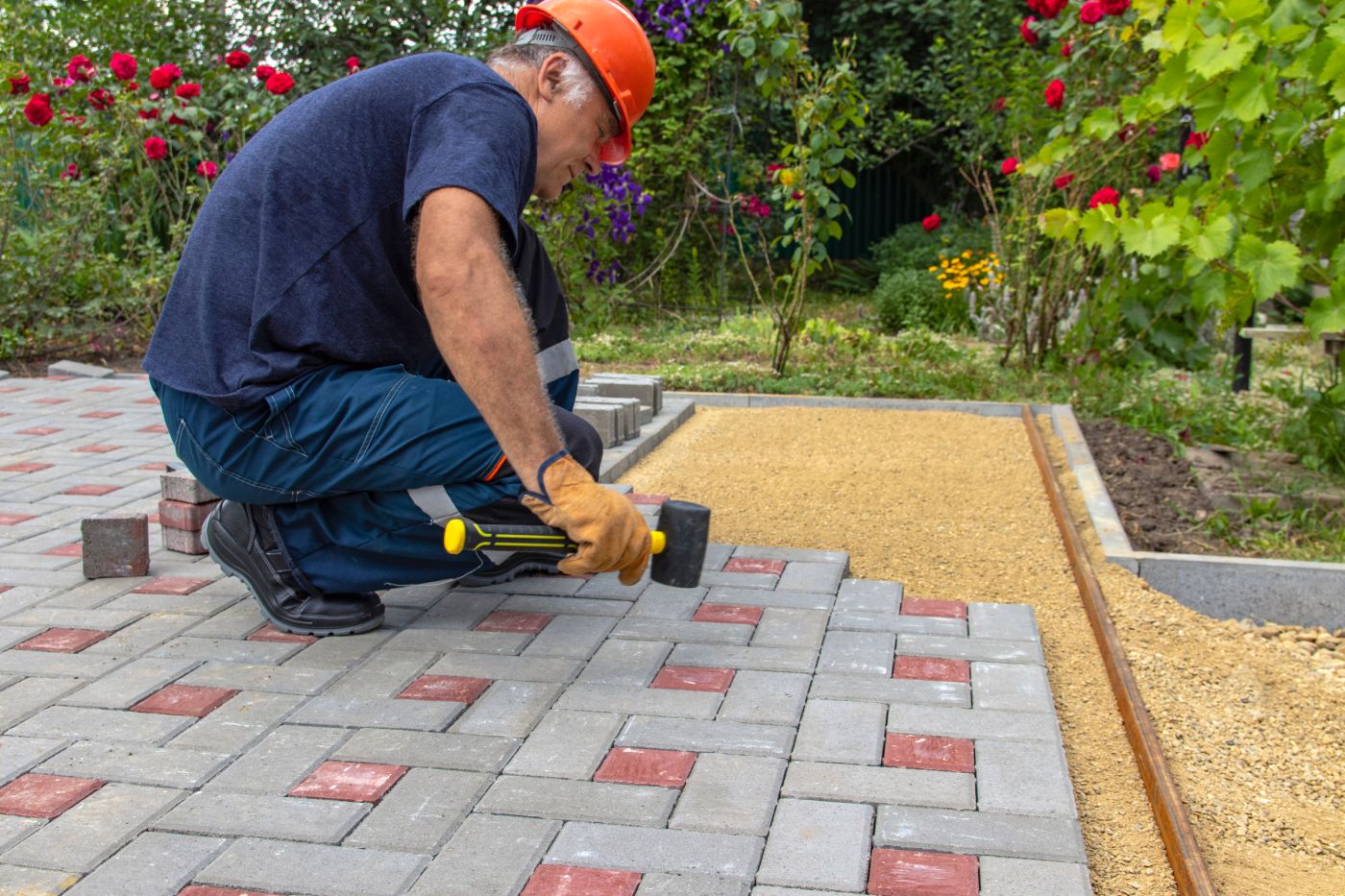
We install layers of crushed stone or aggregate, compacted in stages. This creates a firm, stable platform that allows water to move through rather than collect.
If this step is rushed, the patio may look perfect at first—and begin to sink within a year.
3. Proper Grading
Grading determines where water flows.
A slight slope—often barely visible to the eye—directs water away from structures. The pitch must be precise. Too flat and water pools. Too steep and it becomes uncomfortable to walk on.
4. Drainage Solutions When Needed
Not every yard needs additional systems. But some do.
Depending on your property, we may recommend:
- Channel drains
- French drains
- Dry wells
- Integrated runoff management
These aren’t “add-ons.” They’re preventative safeguards.
Think of drainage as insurance you build into the project—not something you fix later.
Signs Drainage Was an Afterthought
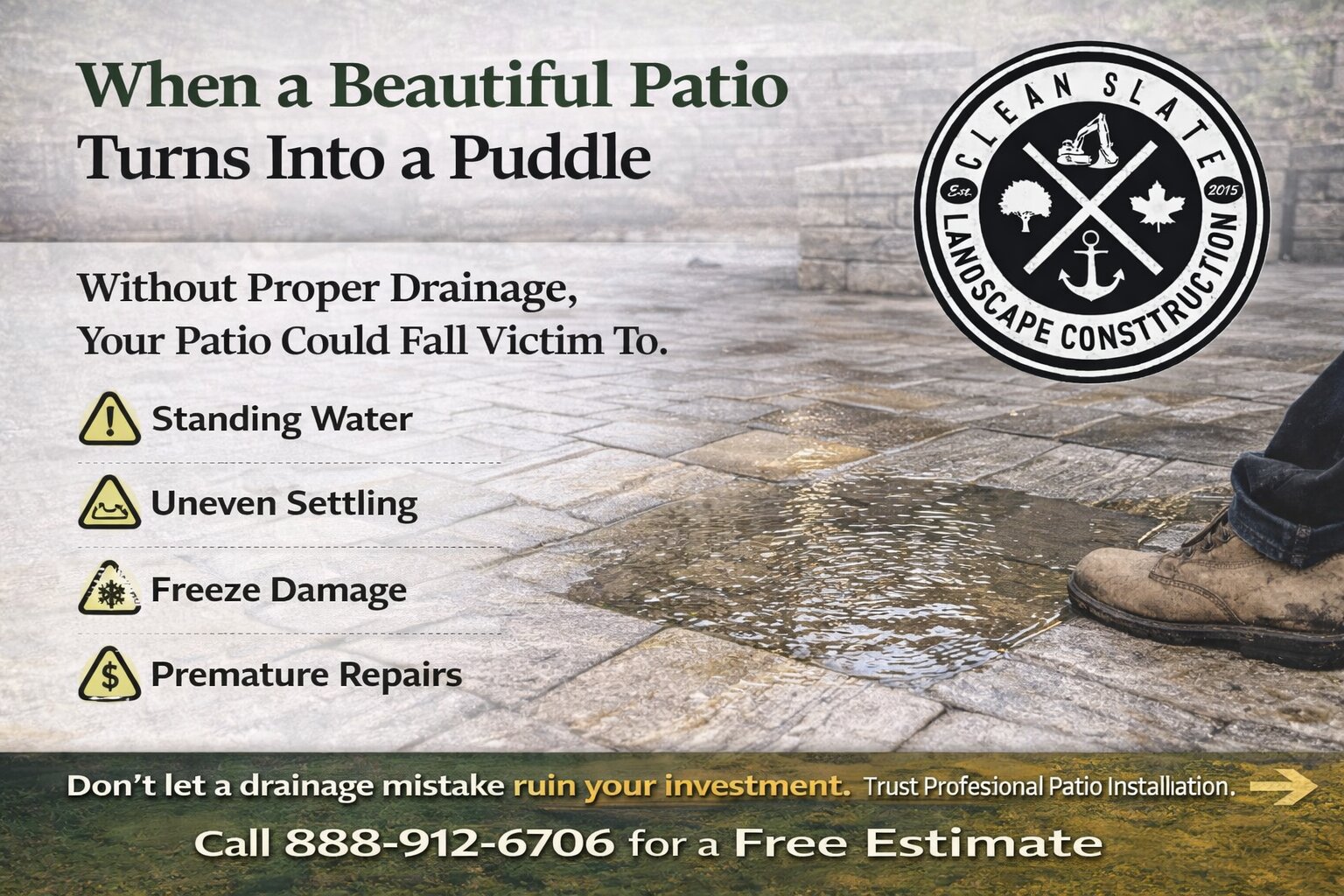
If you’ve ever walked across a patio and felt it rock under your feet, or seen water sitting long after the rain stopped, you’ve seen the consequences.
Here are common warning signs:
- Puddles that linger for hours
- Edges that separate or bow outward
- Sand washing out between pavers
- Uneven settling in certain sections
- Water flowing back toward the house
These issues don’t usually mean the material was bad.
They usually mean water wasn’t managed correctly from day one.
And once water begins undermining the base, repairs become more complex—and more expensive—than doing it properly the first time.
The Emotional Side No One Mentions
Let’s talk about something real for a moment.
When homeowners experience patio problems, it’s not just frustrating—it’s discouraging.
You saved. You planned. You trusted someone.
And now every time it rains, you’re watching through the window to see what happens.
That’s not how this should feel.
A well-built patio should give you peace of mind. It should handle storms quietly in the background while you enjoy your space.
You shouldn’t have to worry every season.
Why Cutting Corners Costs More
In construction, shortcuts often hide beneath the surface.
Reducing excavation depth saves time.
Using less aggregate lowers material cost.
Skipping drainage evaluation speeds up installation.
But here’s the problem: water exposes shortcuts.
And once a patio starts shifting, repairs often require:
- Removing sections of pavers
- Re-excavating unstable areas
- Reinstalling the base correctly
- Replacing damaged materials
That can cost significantly more than doing it right the first time.
We’d rather have the honest conversation up front than offer a low number that creates stress later.
How We Plan for Long-Term Stability
Before any stone is laid, we evaluate:
- The natural slope of your property
- Where water currently flows during storms
- Soil behavior and compaction needs
- Proximity to foundation walls
- Adjacent lawn or landscaping elevations
Sometimes the solution is subtle grading adjustments.
Sometimes it involves adding drainage channels that blend seamlessly into the design.
Either way, our approach is the same:
Move water away from structures.
Protect the base.
Build for decades—not seasons.
Because a patio isn’t temporary décor. It’s hardscape infrastructure.
Questions You Should Feel Comfortable Asking
If this is your first hardscape project, you’re not expected to know construction details.
But you should feel comfortable asking:
- How deep will you excavate?
- What type of base material are you using?
- How is water directed away from my home?
- What happens during freeze-thaw cycles?
- Do I need additional drainage systems?
A trustworthy contractor won’t rush those conversations. They’ll welcome them.
Clear answers build confidence.
Frequently Asked Questions
How much slope should a patio have for proper drainage?
Typically, patios are built with a slight slope—often about 1/8 to 1/4 inch per foot—away from the home. It’s subtle enough that you won’t notice visually, but effective enough to prevent pooling.
The exact pitch depends on layout, size, and surrounding elevation.
What happens if my yard is naturally flat?
Flat yards require more strategic planning. In some cases, additional drainage solutions like channel drains or dry wells are necessary to ensure water doesn’t collect.
A flat yard isn’t a problem—it just requires thoughtful design.
Can poor drainage damage my home’s foundation?
Yes. If water consistently flows toward your house or collects near the foundation, it can contribute to moisture issues, soil expansion, or structural stress over time.
Proper grading helps protect more than just your patio—it protects your home.
Is drainage different for pavers vs. natural stone?
Both require proper base preparation and grading. While materials differ in permeability and installation method, the underlying principle remains the same: water must be directed away and allowed to drain properly.
How long should a properly built patio last?
With correct installation, base preparation, and drainage planning, a patio can last decades. Maintenance may be required over time, but structural integrity should remain strong when water is managed correctly.
Can drainage issues be fixed after installation?
Sometimes, yes—but it depends on severity. Minor grading adjustments may help in early stages. Significant base failure often requires partial removal and reconstruction.
Prevention is always more cost-effective than repair.
If you’re thinking about Patio Installation and want to feel confident—not uncertain—about what’s happening beneath the surface, we’re here to walk you through it clearly and calmly.
Call 888-912-6706 or visit our patio installation and repair services page to learn more about our Patio Installation services in Cape Cod.