
It starts with good intentions.
You step outside after a storm thinking, “Maybe it’ll be better this time.” But within seconds, you’re dodging puddles, sinking into soft ground, or just turning back inside altogether.
It’s not just inconvenient—it’s discouraging.
If you’ve been dealing with this over and over, you’re not missing something obvious. You’re dealing with a structural problem that hasn’t been addressed yet. And once you understand what’s actually going on, the solution becomes much clearer.
If you want to see how this is solved the right way from the start, take a look at how professionals approach patio installation. Because the difference between “temporary improvement” and “lasting change” happens beneath the surface.
It’s Not Just Mud—It’s a Pattern That Keeps Repeating
Mud isn’t the problem.
It’s the result of a system that isn’t working.
When your backyard turns into mud after every rain, it usually means:
- Water has nowhere to go
- The soil is absorbing more than it can handle
- The ground isn’t supported or stabilized
So every storm resets your progress.
It’s not random. It’s predictable.
And that’s actually good news—because predictable problems have reliable solutions.
Why It Feels Like Nothing You Try Works
Most homeowners don’t jump straight to a full patio installation.
They try to fix it themselves first.
Maybe you’ve:
- Added gravel to the wet spots
- Put down stepping stones
- Tried to grow grass
- Leveled out areas with fresh soil
And for a little while, it helps.
Until it doesn’t.
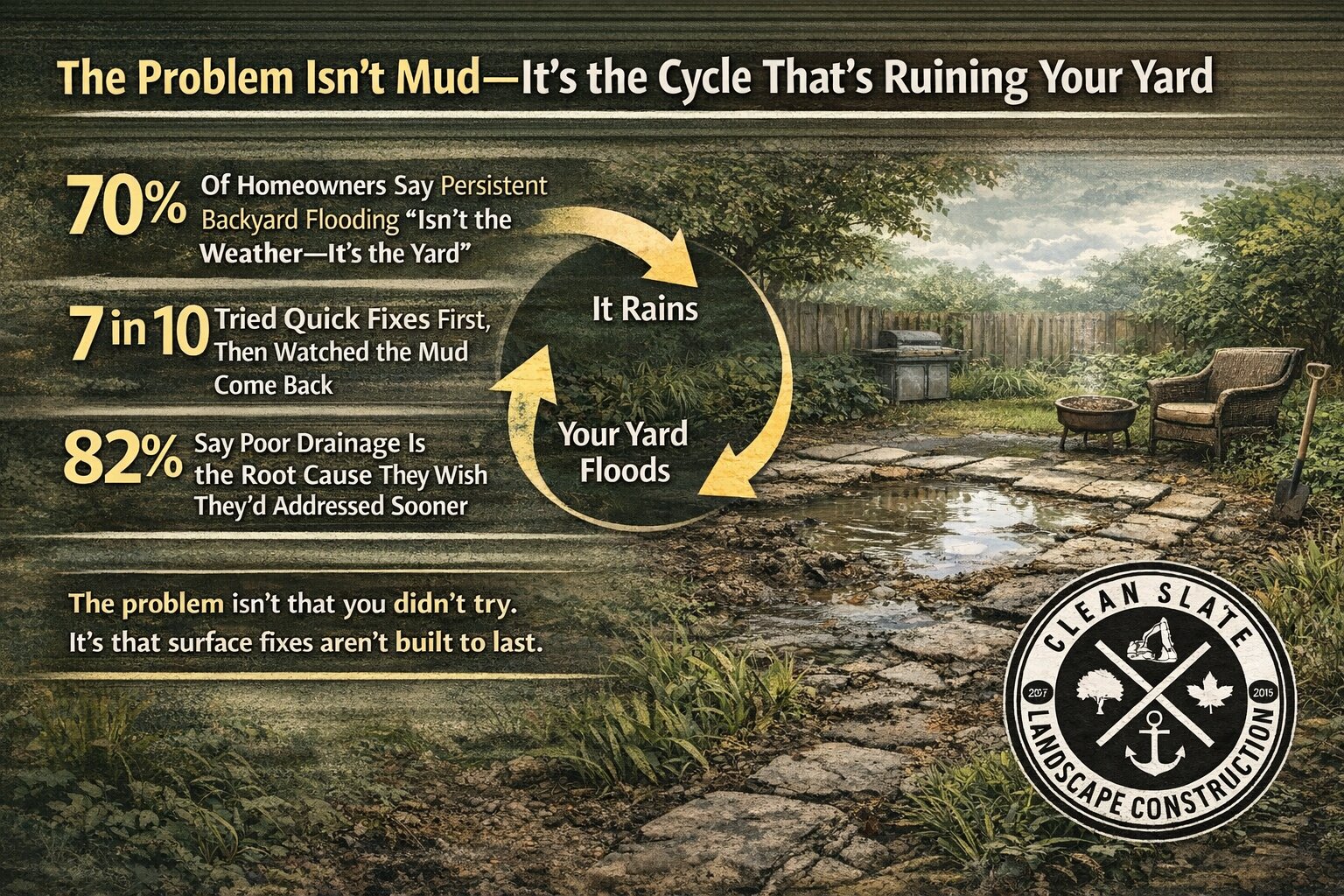
Because those fixes sit on top of the problem, instead of changing the conditions causing it.
Water still collects. The ground still softens. And the cycle starts again.
This is why people start searching for real backyard mud solutions—because surface-level fixes stop feeling worth it.
The Misconception That Leads to Disappointment
A lot of people think:
“A patio will just give us a place to sit.”
So they focus on:
- Paver style
- Color
- Shape
- Layout
But if that’s all the project focuses on, it’s incomplete.
Because a patio isn’t just a surface—it’s a system.
And when that system isn’t built correctly, you don’t just get mud around it… you get problems within it.
Pavers shift. Water pools. Edges sink.
And suddenly, the thing meant to fix the issue becomes part of it.
What a Properly Built Patio Actually Solves
When done right, a patio changes how your yard functions—not just how it looks.
It:
- Creates a stable, compacted surface that won’t sink
- Redirects water away from problem areas
- Prevents soil from becoming oversaturated
- Establishes a usable outdoor space in all conditions
It doesn’t fight the environment. It works with it.
That’s why a well-built patio doesn’t just improve your yard—it restores it.
The Step Most Contractors Rush (And Why It Matters)
Here’s where things get real.
The most important part of a patio isn’t visible when the job is done.
It’s everything underneath.
A proper installation includes:
Excavation
Removing weak, unstable soil that would otherwise shift over time.
Base Preparation
Installing and compacting layers (typically crushed stone) to create a stable foundation.
Grading
Shaping the area so water flows away from the patio—not toward it.
Drainage Planning
Ensuring water has a path to move through and out of the space.
Skipping or rushing these steps makes installation faster.
It also makes failure more likely.
And the frustrating part? You often don’t notice right away.
The issues show up later—when the patio settles unevenly or starts holding water again.
The Emotional Side No One Talks About
There’s a quiet frustration that comes with a backyard you can’t use.
It’s not just about mud.
It’s about:
- Canceling plans because the ground is too wet
- Avoiding parts of your own property
- Feeling like every improvement is temporary
It wears on you over time.
One homeowner said:
“We stopped even thinking of it as a place to relax. It just felt like a problem we kept managing.”
And that’s the shift a proper solution changes.
It turns your yard from something you work around… into something you actually enjoy again.
What Changes When It’s Done Right
After a properly built patio is in place, something subtle but important happens.
You stop thinking about the ground.
You stop checking the weather before stepping outside.
You stop wondering if this rain will undo everything again.
Instead, your backyard becomes predictable. Stable. Usable.
And that consistency is what most people were looking for all along.
You’re Not Expecting Too Much—You’re Expecting It to Work
If part of you has been thinking:
“Why is this so hard to fix?”
That’s valid.
Because it’s not about effort—it’s about approach.
You don’t need more temporary fixes.
You need something built to handle the reality of your yard.
And once that’s in place, the problem doesn’t come back.
FAQ: What Homeowners Ask Before Fixing a Muddy Backyard
Why does my backyard stay muddy for days after rain?
Because the soil is holding water without proper drainage. Without structure, it can’t dry efficiently or evenly.
Will installing a patio completely eliminate mud?
In the areas it covers, yes. And when designed properly, it can improve drainage across the surrounding yard as well.
Is gravel a good long-term fix?
Gravel can help temporarily, but without a proper base and drainage system, it often sinks or gets displaced over time.
How do I know if my yard needs grading?
If water pools, flows toward your home, or creates consistent wet spots, grading is likely part of the solution.
How long does a patio installation take?
Most projects range from a few days to a couple of weeks, depending on size and complexity.
What causes patios to sink or shift?
Usually poor base preparation or inadequate compaction. Without a stable foundation, movement is inevitable.
Is this something I can do myself?
Small projects might be manageable, but for long-term results—especially in problem areas—professional installation is strongly recommended.
You Don’t Have to Keep Living With This
You shouldn’t have to avoid your backyard every time it rains.
You shouldn’t have to redo the same fixes every season.
There’s a real solution—and it doesn’t rely on hoping the weather cooperates.
Ready for a Backyard That Finally Works the Way It Should?
If you’re tired of the cycle and ready for something that actually holds up, there’s a better way forward.
Call 888-912-6706 or explore your options for patio installation to learn more about our Patio Installation services in Cape Cod.