Sometimes the most frustrating problems aren’t the biggest ones.
Maybe your beachside yard is beautiful to look at. The view is exactly what you hoped for when you bought the property. But every time you try to set up the grill, host family dinner outside, or relax in a lawn chair, the same problem appears.
The sand shifts.
Chairs wobble. Tables lean. Grill wheels sink into the ground. What should feel relaxing starts feeling like work.
If you’ve found yourself wondering whether there’s a better solution, you’re not alone. Many homeowners along the Cape struggle with sandy landscapes that don’t function the way they want them to. The good news is that a sandy yard doesn’t mean you have to give up on creating a comfortable outdoor living space. Understanding the available options can help you see possibilities where you may currently see limitations.
If you’re beginning to explore long-term solutions, learning about professional patio installation services can help you understand what may be possible for your property.
The Problem Usually Isn’t the Yard—It’s the Surface
Many homeowners assume they have a bad yard.
In reality, they often have a great yard sitting on an unstable surface.
Beachfront and coastal properties naturally contain sandy soil. That’s part of what makes these locations unique and desirable. Unfortunately, the same soil conditions that support a coastal landscape can create challenges for outdoor living.
Sand doesn’t provide the same support as compacted soil or hardscape surfaces.
As a result:
- Furniture legs sink
- Grills become difficult to level
- Outdoor dining feels awkward
- Fire pits shift over time
- Walking surfaces become uneven
A space that looks inviting can quickly become frustrating when it doesn’t function well.
The issue isn’t that the property lacks potential.
The issue is that the surface isn’t supporting the way you want to use the space.
Why Beachside Properties Require a Different Approach
Many landscaping ideas that work perfectly in suburban neighborhoods struggle near the coast.
Beach environments create unique conditions that influence every outdoor project.
Common challenges include:
Wind-Blown Sand
Even after carefully arranging an outdoor space, wind can move sand throughout the yard.
Over time, this affects both appearance and functionality.
Salt Exposure
Salt in the air can impact certain materials, furniture, and landscape features.
Material selection becomes especially important.
Drainage Conditions
Although sandy soils generally drain well, water movement still requires planning.
Heavy rain can wash away loose material or create unexpected settling.
Constant Surface Movement
Unlike more stable soils, sandy landscapes are always shifting to some degree.
This movement can create ongoing maintenance challenges if outdoor living areas aren’t properly designed.
The best landscape designs work with these conditions rather than fighting them.
Why a Dedicated Gathering Space Makes Such a Difference
Many homeowners spend years trying to improve their entire yard.
Often, they would see greater benefits by focusing on one highly functional area first.
Think about how your family actually uses outdoor space.
Most people want a place for:
- Grilling
- Outdoor dining
- Family gatherings
- Morning coffee
- Watching sunsets
- Entertaining friends
These activities don’t require an acre of perfectly level ground.
They require one dependable space.
Creating a stable outdoor area often becomes the foundation for enjoying the rest of the property.
It’s like creating a living room outdoors.
Once that space exists, the entire yard feels more useful.
Why Patios Are Often the Preferred Solution
When homeowners start searching for answers, they frequently discover that patios solve several problems at once.
A properly designed patio provides:
Stability
Perhaps the most obvious benefit is a solid surface.
Furniture stays level. Grills remain secure. Walking becomes easier and more comfortable.
Lower Maintenance
Unlike constantly shifting sand, hardscape surfaces require significantly less ongoing adjustment.
Better Drainage Management
Professionally installed patios are designed to manage water movement while maintaining surface stability.
Improved Appearance
Patios help define outdoor spaces and create visual structure within the landscape.
Many homeowners are surprised by how much more finished their property feels after installing a patio.
The change often extends beyond functionality.
The entire yard begins to feel more intentional.
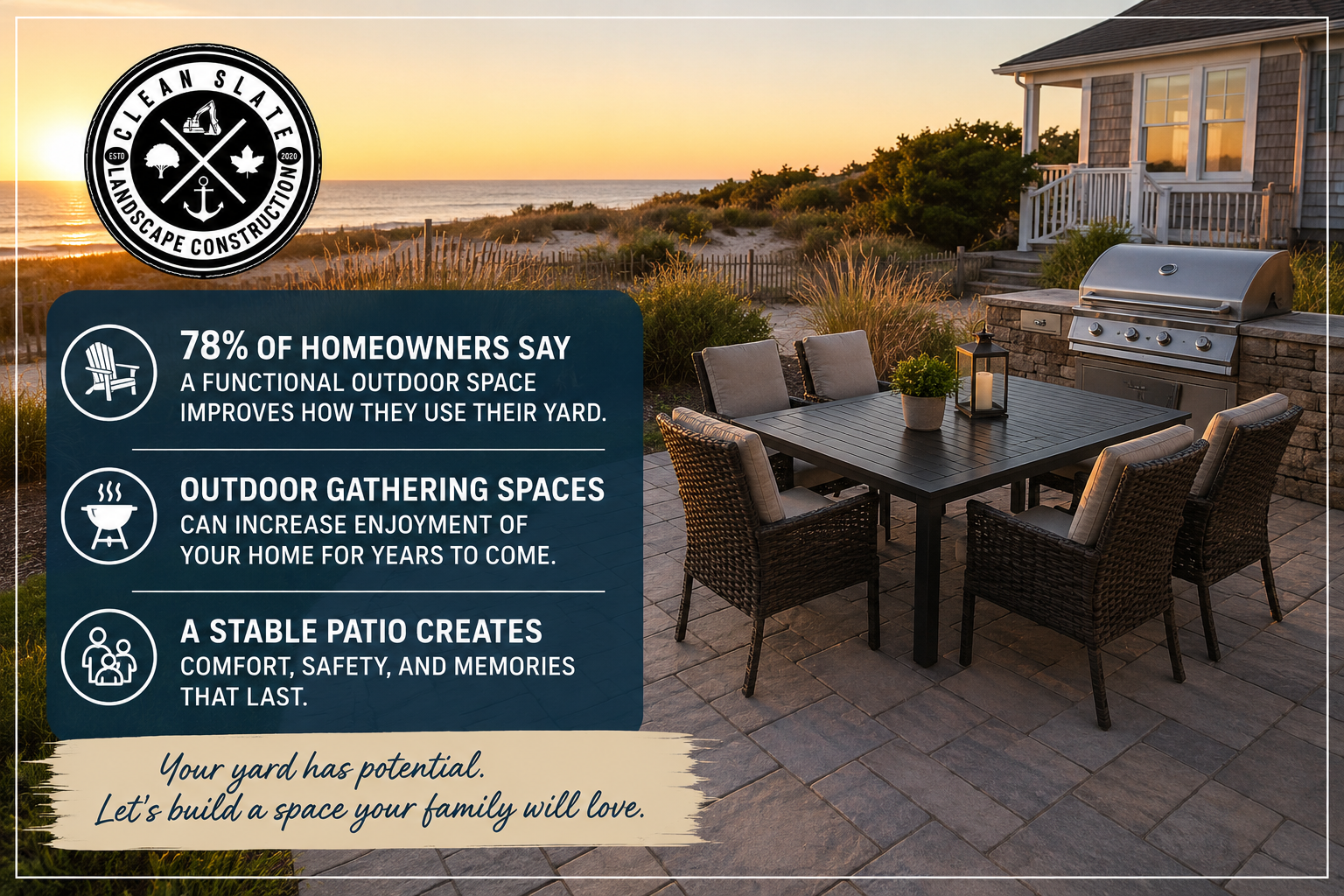
The Hidden Value of Creating Outdoor Living Space
Most homeowners initially focus on solving a practical problem.
They want a stable place for a grill.
They want chairs that don’t sink.
They want a cleaner outdoor environment.
What they often discover is something larger.
A comfortable outdoor space changes behavior.
People spend more time outside.
Families gather more frequently.
Friends stay longer during visits.
Meals move outdoors.
The space becomes part of daily life rather than an area that gets used only occasionally.
It’s difficult to measure that value with a tape measure or calculator.
But homeowners often tell us it’s the biggest benefit of all.
Choosing Materials That Work Near the Coast
Not every material performs equally well in coastal environments.
When planning a patio near the beach, it’s important to consider long-term durability.
Factors often include:
- Salt exposure
- Temperature changes
- Moisture levels
- Surface stability
- Maintenance requirements
Pavers are often popular because they provide flexibility, durability, and attractive design options.
Natural stone may appeal to homeowners looking for a more organic appearance.
The right choice depends on the property’s conditions and the homeowner’s goals.
This is one reason professional guidance can be so valuable.
The best material isn’t always the most expensive one.
It’s the one that performs well in your specific environment.
Finding Inspiration Without Getting Overwhelmed
A quick online search can produce hundreds of outdoor seating area ideas.
While inspiration is helpful, it can also create confusion.
You see large outdoor kitchens, luxury fire features, and elaborate entertainment areas.
Then you look at your sandy backyard and wonder where to begin.
The truth is that successful outdoor spaces rarely start with complexity.
They start with a clear purpose.
Ask yourself:
- How do we actually spend time outside?
- How many people typically gather here?
- Do we entertain often?
- Is grilling the primary activity?
- Do we want dining space, lounging space, or both?
Answering these questions often provides more clarity than scrolling through endless photos online.
The best outdoor space isn’t necessarily the biggest one.
It’s the one that fits your life.
Small Improvements Often Lead to Bigger Transformations
Many homeowners delay projects because they feel overwhelmed by the possibilities.
They assume they need to redesign the entire yard.
In reality, meaningful change often begins with a single improvement.
A stable patio area may eventually lead to:
- Additional landscaping
- Better walkways
- Expanded gathering areas
- Outdoor lighting
- Fire features
- Garden enhancements
The first step creates momentum.
And momentum often changes how people experience their entire property.
Frequently Asked Questions
Can you build a patio on sandy soil?
Yes. Sandy soil can absolutely support a patio when proper preparation and base construction techniques are used.
Will patio furniture still sink if it’s installed on a patio?
No. One of the primary benefits of a properly constructed patio is providing a stable surface that supports furniture, grills, and outdoor features.
What is the best patio material for a beachside property?
The ideal material depends on your specific site conditions, design goals, and maintenance preferences. Pavers and natural stone are both common choices in coastal environments.
Does a patio help reduce sand tracking into the house?
It can. A defined hardscape surface often helps reduce the amount of loose sand that gets carried into the home compared to walking directly through sandy areas.
How large should a grilling patio be?
The answer depends on how you plan to use the space. Many homeowners include room not only for the grill but also for dining furniture and circulation space around the cooking area.
Will a patio increase property value?
Many buyers view functional outdoor living space as a desirable feature. A well-designed patio can improve usability, curb appeal, and overall enjoyment of the property.
Do patios require a lot of maintenance?
Most professionally installed patios require relatively little maintenance compared to traditional lawn areas. Maintenance requirements vary based on material selection.
Can a patio withstand coastal weather conditions?
Yes. Properly designed patios are built to handle weather exposure, drainage demands, and environmental conditions common in coastal regions.
A sandy yard may feel limiting today, but it doesn’t have to stay that way. Many homeowners discover that creating one stable gathering space completely changes how they use and enjoy their property. What starts as a practical solution for a grill and a few chairs often becomes the heart of outdoor family life.
Call 888-912-6706 or visit our Patio Installation services to learn more about our Patio Installation services Cape Cod, MA.