There’s a specific kind of panic that sets in when you notice it.
The wall looks… off.
A slight lean. A widening crack. Soil spilling through seams that used to feel solid.
You walk past it once. Then again. Then you can’t unsee it.
If you’re here, something has already shifted — physically or emotionally. You’re wondering whether this is cosmetic… or the beginning of something much bigger.
We’ve stood in that yard with many Cape Cod property owners. And the truth is this: retaining walls rarely collapse without warning. There are almost always early signs. There are almost always preventable causes.
And there is almost always a solution — especially when addressed early.
If you’re already seeing movement, you can review professional options for retaining wall repair and installation in Cape Cod before the issue escalates.
Let’s talk about what usually goes wrong — and why it doesn’t have to end in total failure.
The Drainage Mistake That Builds Pressure in Silence
Water is the quiet force most people underestimate.
When rainwater or groundwater collects behind a wall and has nowhere to go, it creates hydrostatic pressure. That pressure builds slowly, invisibly, and relentlessly.
The wall may hold for a while.
But pressure doesn’t disappear — it accumulates.
Without proper gravel backfill, perforated drainage pipe, and weep systems, water pushes outward with thousands of pounds of force. Eventually, blocks begin to shift. Joints open. The wall bulges.
On Cape Cod, where heavy rains and coastal moisture are part of life, drainage isn’t optional. It’s structural.
If drainage was skipped, rushed, or poorly installed, collapse becomes a matter of time.
The Base That Wasn’t Prepared Correctly
A wall doesn’t start above ground. It starts below it.
One of the most common causes of structural failure is inadequate base preparation. That means:
- Not excavating deep enough
- Not using compacted crushed stone
- Not compacting in lifts
- Skipping proper leveling
When the base shifts, the wall shifts. And uneven settlement creates weak points that eventually crack or buckle.
It’s similar to building a deck on uneven footings. It may look straight at first — but gravity eventually exposes every shortcut.
The base is invisible when the project is complete. But it determines everything.
Materials Chosen for Appearance — Not Performance
We understand the desire for aesthetics. Stone color. Texture. Style.
But not every product sold for landscaping is engineered to hold back thousands of pounds of soil.
We often see decorative blocks or timbers used in structural situations they weren’t designed for. Over time, they bow or shear under load.
The wrong material choice is one of the most overlooked contributors to failure in Retaining Wall Construction projects — particularly DIY builds or installations completed without load calculations.
When beauty is prioritized over engineering, the wall may look great for a season or two. Then stress reveals the truth.
Soil Conditions That Weren’t Evaluated
Soil is not uniform.
On Cape Cod properties, soil can vary dramatically — sandy in one section, clay-heavy in another. Each type behaves differently when wet, frozen, or compacted.
Clay retains water and expands.
Sand drains quickly but shifts under load.
Freeze-thaw cycles add expansion stress in winter months.
If soil conditions weren’t evaluated before construction, the wall may be absorbing forces it was never designed to handle.
A retaining wall doesn’t just resist gravity. It resists soil behavior.
And soil behavior is powerful.
Building Taller Than the Wall Was Designed For
Height changes everything.
As walls increase in height, lateral pressure increases exponentially. At certain heights, reinforcement systems like geogrid become necessary. Engineering review may also be required depending on local regulations.
When reinforcement is skipped — or the wall is built taller than originally planned — the margin for error disappears.
Leaning walls are often a sign that height and reinforcement weren’t aligned.
A small decorative garden border is very different from a structural wall holding back a slope.
The two should never be built the same way.
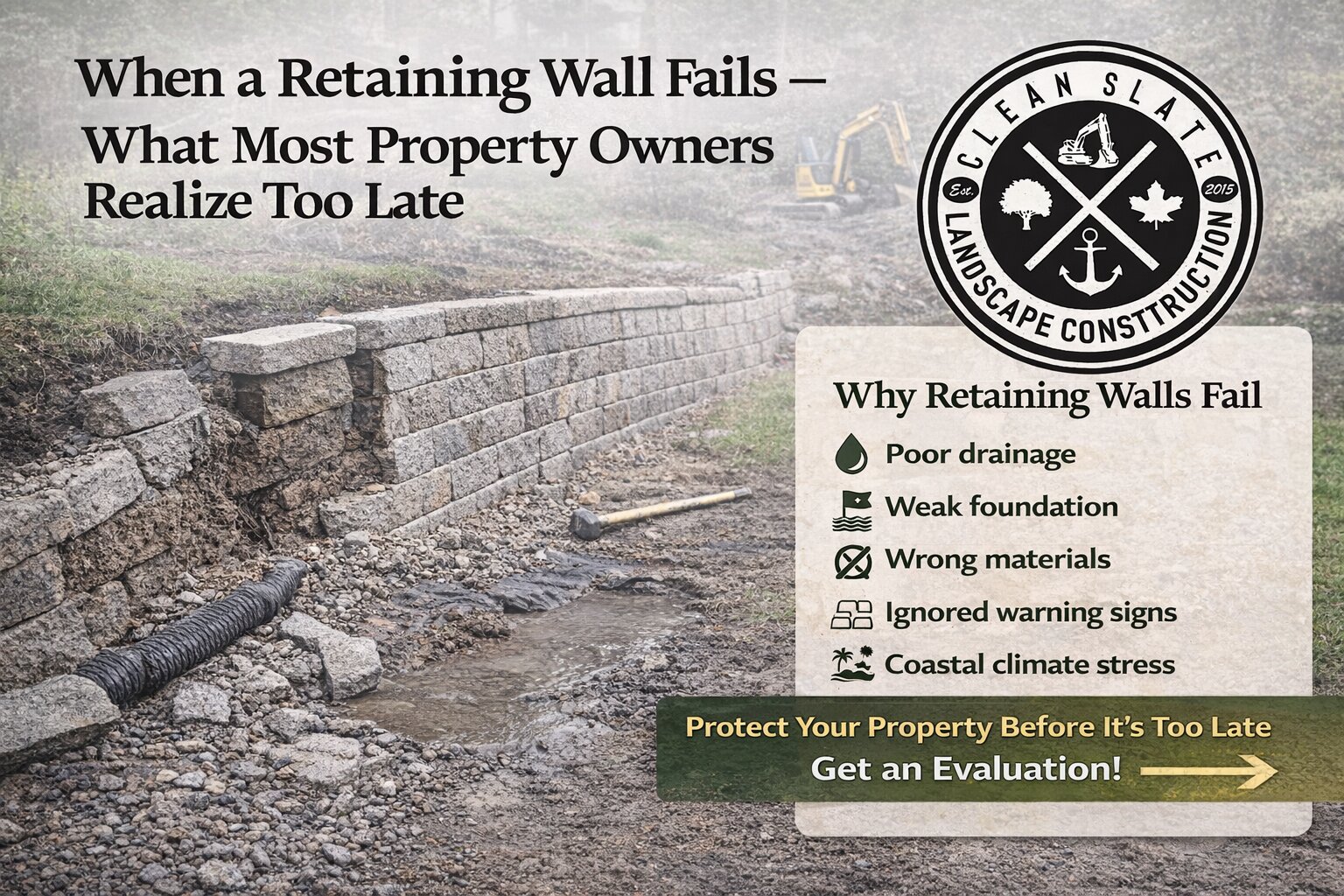
Small Warning Signs That Get Ignored
Here’s something we see often:
A homeowner notices a hairline crack.
Or a slight lean.
Or minor separation between blocks.
It doesn’t look dramatic. So it gets postponed.
But retaining wall failure is rarely sudden. It’s progressive.
Early signs include:
- Horizontal cracking
- Bulging sections
- Soil washing out at the base
- Gaps forming between segments
- Tilting or rotation forward
These are signals — not cosmetic flaws.
Addressed early, reinforcement or partial rebuild may be possible.
Ignored long enough, full structural replacement becomes necessary.
And the cost difference can be significant.
Coastal Climate Stress Most People Don’t Factor In
Cape Cod’s environment adds layers of stress:
- Salt exposure
- Wind-driven rain
- Freeze-thaw cycles
- Sandy shifting subsoils
Even a well-built wall requires design considerations that account for these variables.
Walls that might survive decades inland can deteriorate faster along the coast if drainage, materials, and compaction aren’t optimized for the environment.
Local experience matters here — not just construction knowledge, but regional understanding.
DIY Isn’t the Problem — Incomplete Information Is
We respect homeowners who take pride in improving their properties.
But retaining systems are deceptively complex. A short instructional video rarely covers:
- Load-bearing calculations
- Soil classification
- Drainage engineering
- Compaction requirements
- Reinforcement grids
When walls fail after DIY attempts, it’s rarely due to effort. It’s usually due to missing technical layers that aren’t obvious on the surface.
There’s no shame in needing structural support. There’s wisdom in recognizing when it’s time to bring in reinforcement — literally and figuratively.
The Emotional Side No One Talks About
A collapsing wall isn’t just a structural issue.
It’s stress.
It’s financial concern.
It’s worry about safety — especially if the wall borders a driveway, patio, or foundation.
Many property owners feel frustration or embarrassment when a wall fails.
Please hear this clearly:
Most wall failures trace back to original installation shortcuts, not homeowner neglect. Often those shortcuts happened years ago.
The important question isn’t “Who’s to blame?”
It’s “What’s the safest, smartest next step?”
When built correctly, retaining systems can last decades. Thoughtful Retaining Wall Construction is about longevity, not just installation.
Frequently Asked Questions
How do I know if my retaining wall is about to collapse?
Look for visible leaning, horizontal cracking, bulging sections, or soil washing out behind the wall. If blocks are separating or tilting forward, structural pressure is already active. Early evaluation can prevent full failure.
Can a leaning retaining wall be repaired?
In many cases, yes — especially if caught early. Reinforcement, drainage correction, or partial rebuilding may restore stability. However, severely compromised walls may require full reconstruction to ensure long-term safety.
Is drainage really that important?
Absolutely. Poor drainage is one of the leading causes of failure. Water pressure builds silently and can exceed the wall’s design limits. Proper gravel backfill and drainage systems are critical for longevity.
How long should a properly built wall last?
With correct base preparation, drainage, materials, and reinforcement, a well-built retaining system can last 30–50 years or more. Environmental conditions and maintenance also play a role.
Is it dangerous to leave a damaged wall alone?
It can be. A collapsing wall can damage landscaping, patios, driveways, and even foundations. In some cases, it may pose safety risks if located near walkways or parking areas.
Does homeowners insurance cover wall collapse?
Coverage varies widely by policy. Some policies may cover sudden collapse but not gradual failure due to installation defects. It’s best to review your policy and consult your provider.
What should I do first if I notice movement?
Document the changes with photos. Avoid adding additional load near the wall (such as heavy equipment or stored materials). Then schedule a professional evaluation to assess structural integrity.
If your wall is shifting, cracking, or leaning, you don’t have to sit with that uncertainty.
Clear answers reduce stress. Structural clarity brings peace of mind.
Call 888-912-6706 or visit our Retaining Wall Construction services in Cape Cod to learn more about how we can help protect your property for the long term.