I’m not proud of how long we waited.
The wall had been “fine” for years—if your definition of fine includes cracks, a slight lean, and mulch that kept washing downhill every time it rained.
We kept telling ourselves it wasn’t urgent.
Then one storm made it clear: we weren’t dealing with a cosmetic issue. We were dealing with slow structural failure. And that realization led us to explore professional retaining wall construction and repair services in Cape Cod.
If you’re skeptical, hesitant, or quietly hoping your wall will just hold on a little longer—I get it. I was you.
Here’s what changed.
Before: The Slow Creep We Pretended Not to See
At first, it was subtle.
A hairline crack near the center. One capstone that didn’t sit perfectly level. Soil pushing slightly outward after heavy rain.
It was easy to dismiss.
We blamed the freeze-thaw cycles. Cape winters can be brutal. Everything shifts a little, right?
But the signs kept stacking up:
- The middle section bowed outward about an inch
- Water pooled behind the wall instead of draining
- The patio edge began separating
- Grass near the slope struggled to root
None of it felt catastrophic. That’s the trap.
Retaining systems rarely collapse overnight. They fail gradually—quietly—while pressure builds behind them.
And if I’m honest, skepticism played a role.
I didn’t want to invite a contractor over only to hear, “This all needs to be replaced.” I didn’t want to feel pushed into something expensive.
So we waited.
The Real Problem: Water and Pressure
The turning point came after a particularly heavy rain.
The bow had worsened. The center dipped noticeably. One block had shifted enough to create a visible gap.
What we learned later was simple but eye-opening: it wasn’t the blocks failing. It was the drainage.
Water had nowhere to go. Soil became saturated. Hydrostatic pressure pushed outward. Year after year.
No dramatic landslide. Just slow movement.
Once I understood that, the issue felt less like “a bad wall” and more like “a system that was built without enough long-term planning.”
That difference mattered.
Calling for an Evaluation (Without the Sales Pitch)
I expected the typical routine:
- A dramatic assessment
- Vague technical talk
- An oversized proposal
Instead, the conversation was practical.
They walked the entire slope—not just the damaged section. They pointed out where the base had settled unevenly. They explained how proper backfill and drainage fabric should have been installed. They showed us how the grade above the wall contributed to water flow issues.
And here’s what stood out:
They didn’t try to sell us more than we needed.
In fact, they recommended keeping a section that was still structurally sound. That’s when my skepticism started to soften.
Good work doesn’t need exaggeration.
The Plan: Rebuild the Foundation, Not Just the Face
This is where I realized something important.
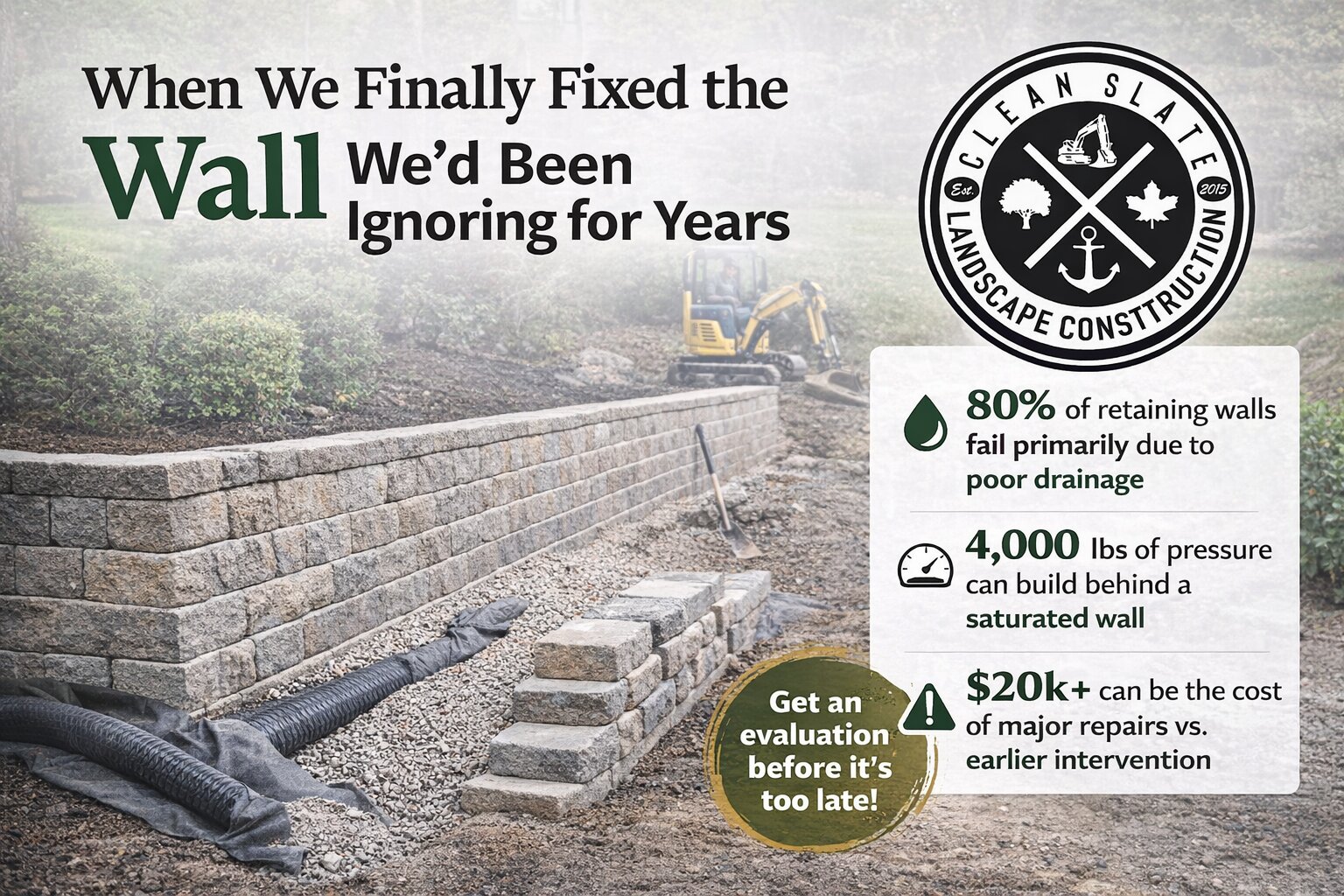
What we had originally was mostly cosmetic. Blocks stacked with minimal base preparation. Limited drainage. No reinforcement for long-term soil pressure.
The new plan focused on what you don’t see:
- Excavating to proper depth
- Compacting a solid aggregate base
- Installing drainage stone and fabric
- Incorporating a proper drain system
- Reinforcing alignment and stability
It wasn’t about making it look nicer.
It was about making it last.
That shift in mindset changed how I viewed the investment entirely.
During Construction: Controlled, Not Chaotic
I’d braced for disruption.
But the process was methodical.
The failing structure came out in sections. The soil behind it was carefully removed and replaced. Drainage components were installed before the first new block went in.
There’s something reassuring about watching a foundation get built correctly.
Every layer had purpose. Every alignment was checked. It wasn’t rushed.
Yes, there was equipment. Yes, there was noise.
But there wasn’t stress.
And that surprised me most.
After: Stability Feels Different
The finished wall looks sharp. Clean lines. Level capstones. Defined slope.
But what I didn’t expect was the emotional shift.
The yard feels settled now.
Rainstorms don’t trigger anxiety. Water flows where it should. The patio edge feels anchored again.
It’s subtle, but it matters.
Living with something slowly failing in your peripheral vision takes up mental space. Fixing it gives that space back.
That’s the part no one talks about.
What I’d Tell Another Skeptic
If your wall is leaning, cracking, or separating even slightly, here’s what I’ve learned:
- Small movement usually means pressure has already built up behind it.
- Cosmetic fixes won’t solve structural problems.
- Proper drainage is everything.
- An honest evaluation costs less than long-term damage.
You don’t have to commit to anything.
But you do deserve clarity.
If you’re considering Retaining Wall Construction for a failing or outdated structure, the key is finding a team that explains the “why,” not just the price.
Frequently Asked Questions
How do I know if my wall needs repair or full replacement?
Minor cracks or surface wear may only require targeted repairs. But visible leaning, bulging sections, drainage failure, or separation between blocks often indicate deeper structural issues. An on-site evaluation is the only way to determine whether reinforcement or full reconstruction is the safer option.
Can’t I just patch the cracks and leave the rest?
Surface patching addresses appearance, not pressure. If water buildup or improper base preparation caused the movement, cosmetic repairs won’t stop future shifting. In many cases, patching delays the inevitable and increases long-term cost.
How long does a rebuild typically take?
It depends on the size, access to the site, and soil conditions. Smaller residential projects may take a few days, while larger or more complex slopes can take longer. A structured, well-planned approach matters more than speed.
Will construction destroy my yard?
A professional team plans access carefully to minimize disruption. Some impact is unavoidable, especially with excavation, but the goal is controlled restoration—not chaos. A good contractor protects surrounding landscaping whenever possible.
What causes most retaining systems to fail?
The most common causes include:
- Poor drainage
- Inadequate base compaction
- Freeze-thaw cycles
- Soil overloading
- Improper installation techniques
Water pressure is often the main culprit. When it has nowhere to go, it pushes outward.
Is rebuilding really worth the investment?
If the structure is protecting your foundation, patio, driveway, or preventing erosion, then yes. Ignoring structural movement can lead to more expensive repairs down the line. A properly built system adds both stability and long-term property value.
How long should a properly built wall last?
With correct base preparation, drainage, and installation, a professionally built system can last decades. Longevity depends heavily on materials, soil conditions, and ongoing maintenance.
If you’re still unsure, that’s okay. Skepticism isn’t negativity—it’s caution. And caution is smart when it comes to your home.
But waiting doesn’t reduce pressure. It only gives it more time.
Call 888-912-6706 or visit our retaining wall construction and repair services in Cape Cod to learn more about our Retaining Wall Construction services in Cape Cod.