The first storm feels manageable.
The second one feels different.
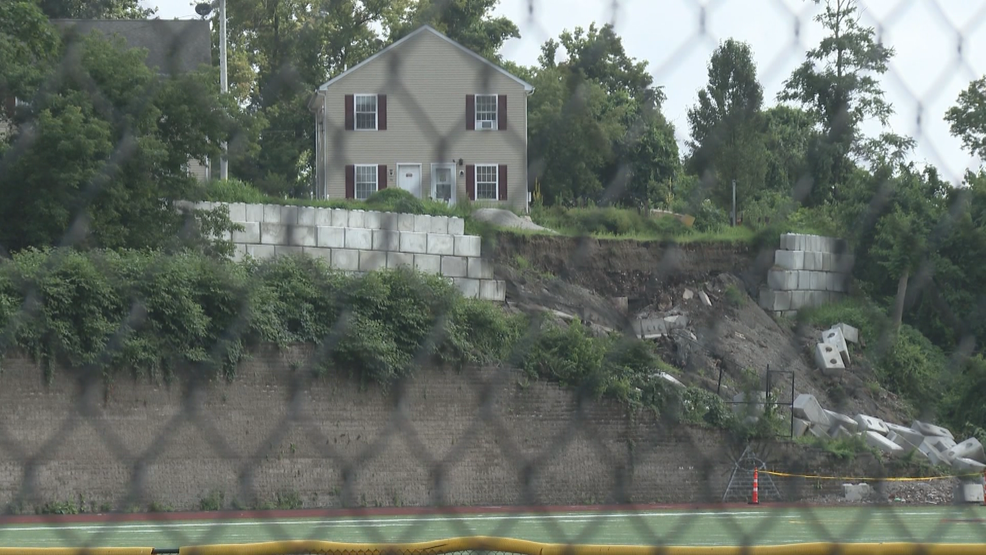
You start watching the base of the wall. You notice water pooling where it never used to. Maybe there’s a slight lean you don’t remember seeing before.
And the question hits: How long can this actually hold?
If you’re asking that, you’re not being dramatic. You’re being smart.
Before anything else — if you want to understand what a properly engineered structure should look like in our region, review our retaining wall services on Cape Cod. Then let’s talk honestly about what happens when water pressure rises.
Because here’s the truth most homeowners don’t get until it’s too late:
A wall doesn’t fail all at once.
It weakens quietly — then gives way suddenly.
A Wall Is Designed for Earth — Not Moving Water
Most landscape walls are built to resist lateral soil pressure. That’s predictable. Engineers can calculate it.
Floodwater changes everything.
Water introduces:
- Dynamic force
- Rapid saturation
- Shifting soil conditions
- Hydrostatic pressure buildup
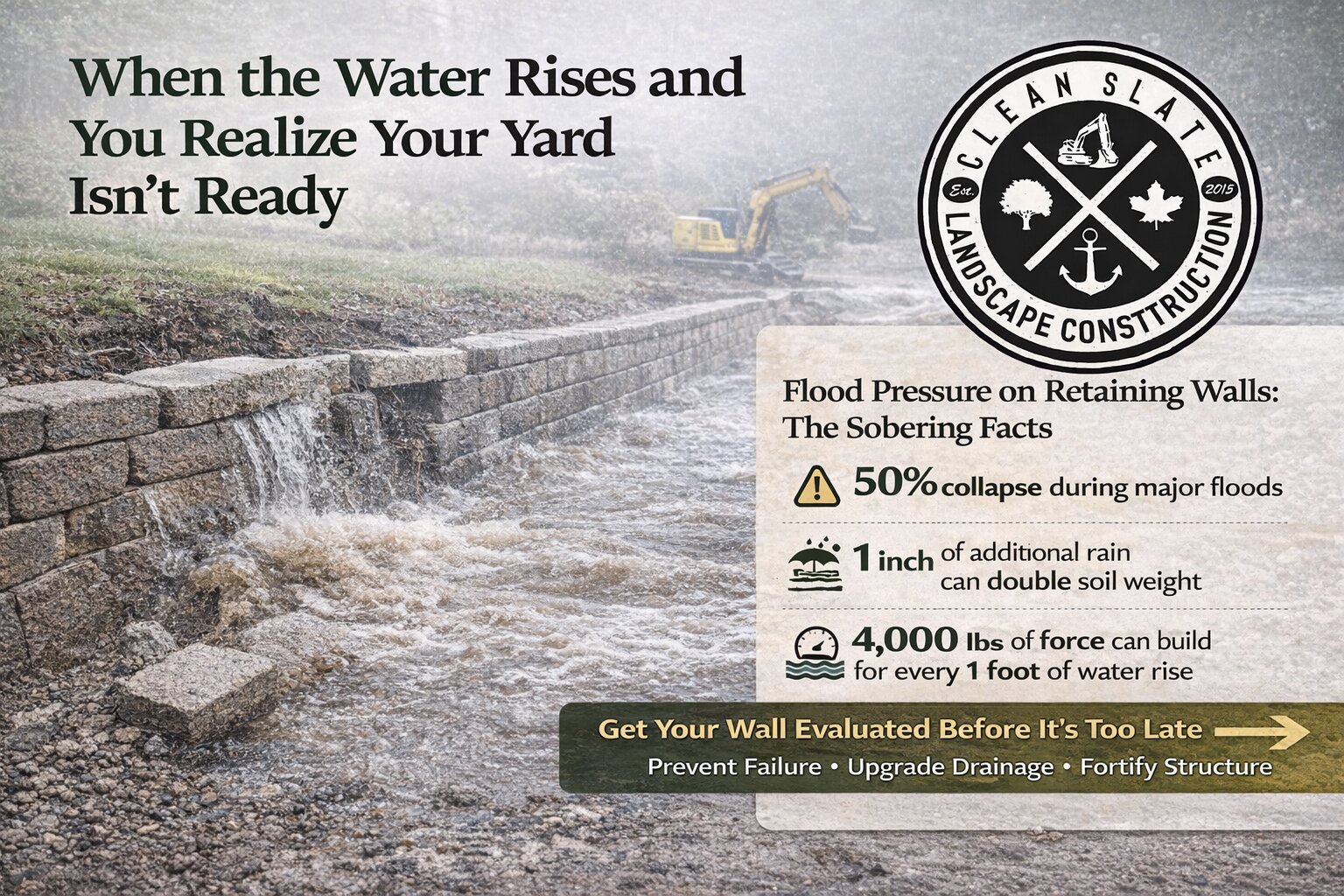
When water accumulates behind a wall with nowhere to drain, pressure increases exponentially. It’s not just “wet soil.” It’s thousands of pounds of outward force pressing against masonry.
A standard decorative wall may hold back dirt for decades.
It may not survive 12 hours of trapped floodwater.
How Long Can It Actually Hold?
There isn’t a universal timeline. It depends on three variables:
1. Drainage Design
The single biggest factor in survival is drainage.
A well-built wall includes:
- Perforated drain pipe at the base
- Gravel backfill
- Filter fabric
- Weep holes
- Proper grading above
If water can escape, pressure stays controlled. If it can’t, the clock starts ticking.
In severe flood conditions with poor drainage, structural compromise can happen within hours.
2. Soil Type
In Cape Cod, we often deal with sandy soil — which drains faster than clay but can shift under heavy saturation.
When soil becomes fully saturated, its weight can nearly double. That additional mass pushes outward against the wall face.
Heavy clay soils are worse under flooding. They trap water. Pressure builds fast.
Either way, saturated soil equals increased load.
3. Construction Quality
Not all walls are built equally.
Retaining Wall Construction done with engineering principles — reinforcement grids, proper base depth, compacted backfill — can withstand substantial stress.
Walls built purely for appearance, without reinforcement or proper base preparation, are far more vulnerable.
The difference isn’t always visible from the outside.
The Physics Behind Failure
Here’s what actually happens during a flood event:
- Rain saturates the ground.
- Water collects behind the wall.
- Drainage (if inadequate) becomes overwhelmed.
- Hydrostatic pressure increases.
- Soil weight multiplies.
- The wall begins to deflect outward.
You might notice:
- A slight bow
- Cracks along mortar lines
- Separation at joints
- Soil leaking through seams
Those are early warnings.
Once deflection begins, structural integrity weakens. Continued pressure accelerates failure.
It’s like bending a credit card. It holds. It flexes. Then it snaps.
Coastal Conditions Raise the Stakes
Living near the coast introduces additional forces:
- Storm surge
- High groundwater tables
- Salt exposure
- Freeze-thaw cycles
In Cape Cod, nor’easters can push both surface water and groundwater levels up simultaneously.
That means your wall isn’t just fighting rainfall runoff. It’s battling rising subsurface pressure too.
Add years of freeze-thaw expansion and salt intrusion weakening mortar — and resilience decreases over time.
A wall that survived five storms may not survive the sixth.
What Most Contractors Won’t Tell You
Some walls were never designed for flood resistance.
They were built to:
- Level a patio
- Create planting tiers
- Add curb appeal
Not to function as a water barrier.
If your property sits:
- At the base of a slope
- Near shoreline elevation zones
- In a low-lying neighborhood
- Adjacent to heavy runoff channels
…you cannot assume your existing wall was engineered for flood loads.
This is where professional assessment matters.
And yes — Retaining Wall Construction, when engineered properly from the ground up, dramatically improves survivability.
But inspection comes first.
Early Warning Signs You Should Not Ignore
You might be at risk if:
- The wall leans more than 1–2 degrees outward
- Cracks appear wider after heavy rain
- Soil washes out from behind
- Water pools at the base instead of draining
- Sections appear to separate
These aren’t cosmetic flaws.
They’re stress signals.
Waiting until visible collapse means you’re already late.
The Cost of Failure Is Bigger Than the Wall
When a retaining structure fails during flooding, the damage can cascade:
- Washed-out landscaping
- Patio collapse
- Erosion exposing foundations
- Flooding into basements
- Structural undermining
What looks like a yard feature can quietly be protecting tens of thousands of dollars in surrounding infrastructure.
I say this directly because I’ve seen the aftermath:
Homeowners thought they had time.
Water doesn’t negotiate.
What You Should Do Before the Next Storm
If you’re proactive — good. Stay that way.
Here’s a smart pre-storm checklist:
- Clear all visible drainage outlets.
- Ensure downspouts are directing water away from the wall.
- Check for pooling water behind the structure.
- Inspect for new cracks after heavy rain.
- Confirm grading slopes away from the wall, not toward it.
If anything looks questionable, get it evaluated before peak storm season.
You don’t want your first structural inspection to happen after a collapse.
If you’re local, you can review structural and masonry solutions available in Cape Cod and determine whether reinforcement, drainage upgrades, or rebuild options make sense for your property.
The right fix now costs a fraction of emergency restoration later.
FAQ: Flooding and Structural Landscape Walls
Can a retaining wall completely stop a flood?
No. Most residential walls are not designed to function as flood-control dams. They can redirect or slow water, but without engineered flood design and drainage, they are vulnerable to hydrostatic pressure buildup.
How long can a well-built wall hold back floodwater?
If properly engineered with adequate drainage, reinforcement, and base support, it can withstand prolonged heavy rain events. However, extreme flood conditions (storm surge or flash flooding) can exceed residential design limits. Performance depends on soil type, water volume, and duration.
What causes most retaining wall failures during storms?
The primary cause is trapped water. Hydrostatic pressure builds behind the wall when drainage is inadequate or overwhelmed. Saturated soil weight also increases outward force significantly.
Does sandy soil make flooding safer for walls?
Sandy soil drains faster than clay, which helps reduce prolonged pressure. However, sand can also shift and erode more easily under heavy runoff, potentially undermining the wall’s base.
Can adding drainage improve an existing wall?
In many cases, yes. Retrofitting drainage systems such as perforated pipe, gravel backfill, or improved grading can significantly reduce hydrostatic pressure. A professional inspection is necessary to determine feasibility.
Are taller walls more likely to fail?
Height increases lateral pressure, but height alone does not determine failure. Proper reinforcement, base depth, and drainage are more critical than height by itself.
Should I rebuild or reinforce?
That depends on current structural integrity. Minor leaning and drainage issues may be correctable. Significant bowing, cracking, or foundation undermining often requires partial or full reconstruction.
Direct Advice, Not Alarm
If you live in a flood-prone or coastal area, assume water will test your property eventually.
The question isn’t if.
It’s when.
A properly engineered structure can protect your landscape and home for decades.
A decorative wall under flood pressure may hold… until it doesn’t.
If you want clarity instead of guesswork, now is the time.
Call 888-912-6706 or visit our Retaining Wall Construction services to learn more about our Retaining Wall Construction services in Cape Cod.