
It usually starts small. A patch of dirt missing. A little slope forming where it used to be flat. Then one storm hits harder than expected—and suddenly your yard looks different.
If you’ve found yourself wondering how to stop your yard from washing away, you’re not overreacting. You’re noticing a real problem early. And that’s a good thing.
If you want to understand what a long-term fix looks like, this guide will walk you through it—and you can explore how professionals approach retaining wall construction as a permanent solution.
The Myth: “It’s Just a Bad Storm—It Won’t Keep Happening”
A lot of homeowners assume erosion is tied to a single storm.
Something unusual. A one-off.
But if your yard has already started shifting, it means the structure of your land isn’t prepared to handle heavy water flow.
And on places like Cape Cod—where coastal weather and sandy soil are part of everyday life—that pattern tends to repeat.
What looks like “just one storm” is often the beginning of a cycle.
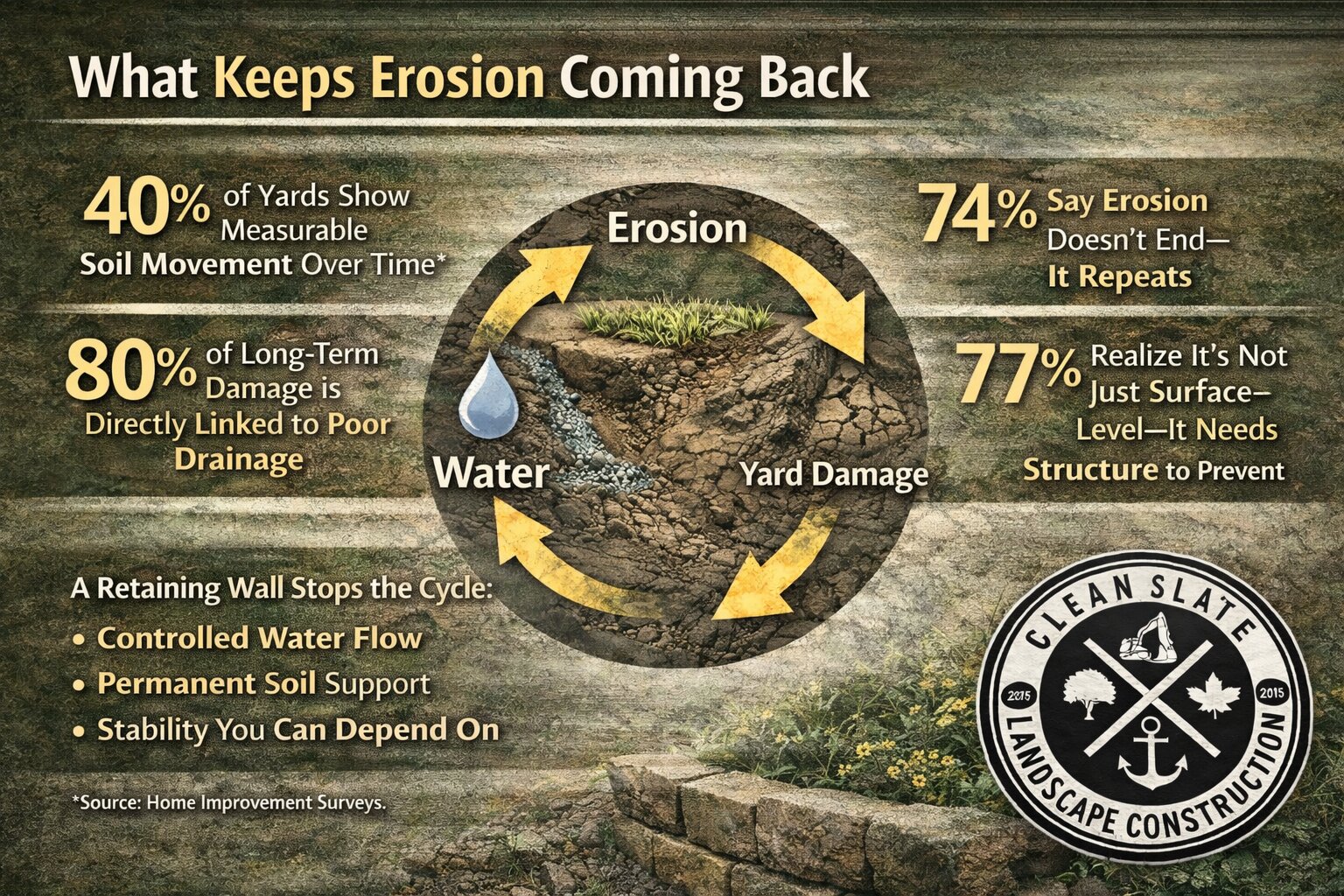
Rain hits → water flows downhill → soil moves → ground weakens → next storm hits harder.
It doesn’t fix itself. It accelerates.
What’s Really Causing Your Yard to Wash Away
At its core, erosion is about movement.
Water is moving too fast—and your yard isn’t built to slow it down.
Here are the most common underlying causes:
1. Sloped or Uneven Terrain
Even a gentle slope can create enough momentum for water to pull soil with it over time.
2. Poor Drainage Planning
If water doesn’t have a clear path, it creates its own—and that path often runs through your yard.
3. Loose or Sandy Soil
Certain soil types, especially in coastal regions, don’t hold together well under pressure.
4. Lack of Structural Support
Without reinforcement, soil has nothing to “push against” when water pressure builds.
This is why many homeowners eventually start searching for yard erosion solutions—because the problem keeps returning no matter how many surface-level fixes they try.
Why “Quick Fixes” Can Feel Like They Work (Until They Don’t)
You might have already tried:
- Replacing washed-out soil
- Adding grass seed or sod
- Spreading mulch or gravel
- Installing small drainage pipes
These aren’t wrong—they’re just incomplete.
They treat the surface, not the force behind it.
It’s a bit like sweeping water out of a boat without patching the leak.
For a few weeks (or even months), things look better. Then the next heavy rain resets everything.
And that cycle can feel exhausting.
The Moment Most Homeowners Realize They Need Something More
There’s usually a turning point.
It might be:
- Water pooling near your foundation
- Sections of your yard becoming unusable
- Repeating repairs every season
- Visible dips, cracks, or shifting soil
That’s when it becomes clear this isn’t just landscaping—it’s structural.
And that’s where retaining walls come in.
What a Retaining Wall Actually Does (Beyond Looks)
A retaining wall isn’t just about appearance—it’s about control.
It changes how your yard interacts with water.
Here’s what it does:
Holds Soil in Place
Instead of allowing gravity and water to pull soil downhill, the wall creates a firm boundary.
Slows and Redirects Water
With proper drainage behind it, water is guided safely away instead of building pressure.
Creates Stability Over Time
The ground stops shifting. Plants take root more effectively. The space becomes usable again.
Protects What Matters
In some cases, retaining walls help protect driveways, patios, or even your home’s foundation.
One homeowner put it simply:
“Before the wall, every storm felt like damage control. After it, we stopped worrying.”
That peace of mind is part of the solution.
What “Done Right” Really Looks Like
Not all retaining walls are built the same.
And this is where many projects go wrong.
A proper build includes:
Site Evaluation
Understanding slope, soil type, and water flow patterns.
Excavation and Base Preparation
Creating a stable foundation that won’t shift under pressure.
Drainage System Installation
Gravel backfill, perforated pipes, and outlets to manage water safely.
Reinforcement
Depending on height and load, walls may require geogrid or other structural support.
Material Selection
Stone, concrete blocks, or other materials chosen based on durability and environment.
Skipping these steps might save money upfront—but often leads to failure later.
And rebuilding costs more than doing it right the first time.
A Quiet Kind of Relief: When the Problem Stops Coming Back
There’s something deeply relieving about walking outside after a heavy rain—and seeing your yard exactly as you left it.
No new damage. No fresh worry.
Just stability.
That’s what a real solution gives you.
Not a temporary fix. Not a seasonal patch.
A stop to the cycle.
FAQ: What Homeowners Usually Ask Before Taking the Next Step
How do I know if I really need a retaining wall?
If your yard repeatedly washes away, develops uneven slopes, or shows signs of soil movement after rain, it’s likely more than a minor issue. A professional evaluation can confirm whether structural support is needed.
Are retaining walls expensive?
Costs vary depending on size, materials, and site conditions. While it may feel like a bigger investment upfront, it often saves money long-term by preventing repeated repairs and property damage.
How long does a retaining wall last?
When built correctly with proper drainage, a retaining wall can last decades. Poor installation, however, can lead to failure within just a few years.
Can I build a retaining wall myself?
Small decorative walls may be DIY-friendly, but anything involving erosion control or structural support should be professionally designed and installed to avoid long-term issues.
Will a retaining wall fix all drainage problems?
It’s a major part of the solution, but often works alongside other drainage strategies. The goal is to manage water flow—not just block it.
What’s the best material for a retaining wall?
It depends on your yard and goals. Natural stone offers a classic look, while engineered blocks provide strength and consistency. A professional can recommend the best fit.
How long does installation take?
Most projects take anywhere from a few days to a couple of weeks, depending on complexity, weather, and size.
You Don’t Have to Keep Guessing
If your yard keeps washing away, it’s not because you haven’t tried hard enough.
It’s because the problem needs the right kind of solution.
And once it’s handled properly, it stays handled.
Ready for a Yard That Finally Holds Its Ground?
You deserve a yard you don’t have to worry about every time it rains.
Call 888-912-6706 or explore your options for retaining wall construction to learn more about our Retaining Wall Construction services in Cape Cod.