
It seems like a simple choice—until it isn’t.
You stand there looking at your yard, maybe after another storm, trying to decide what will actually hold everything in place this time. Block or stone. Clean lines or natural texture.
But this decision carries more weight than most people realize.
If you want to see how this is handled the right way from the start, take a look at how professionals approach retaining wall construction. Because the difference between “looks good” and “actually works” isn’t small—it’s everything.
The Quiet Oversight That Causes Most Failures
Most homeowners don’t get bad advice.
They get incomplete advice.
A contractor might walk you through materials, pricing, and timelines. They might even show you photos of past work.
But what often gets skipped is this:
How will this wall perform five years from now?
Not how it looks. Not how fast it can be built.
How it holds.
Because retaining walls don’t fail dramatically at first. They fail slowly.
A slight lean. A small crack. Soil pushing where it shouldn’t.
And by the time it’s obvious, the repair is no longer small.
Why the “Right Choice” Isn’t Just About Material
It’s easy to get stuck comparing materials like you’re picking countertops.
Block vs stone. Modern vs natural. Budget vs premium.
But retaining walls aren’t decorative decisions. They’re structural systems.
And the real question is:
What system will handle the pressure your yard creates?
That’s why so many homeowners end up researching block vs stone retaining wall options after getting conflicting opinions.
Because the answer isn’t universal.
It depends on:
- Your slope
- Your soil
- Your drainage
- Your long-term expectations
Without that context, any recommendation is incomplete.
The Truth About Block Walls (That Doesn’t Get Said Clearly)
Block retaining walls are popular for a reason.
They’re engineered systems designed for strength and consistency. When installed correctly, they can handle significant pressure and last for years.
They offer:
- Uniform structure
- Built-in locking systems
- Compatibility with reinforcement materials
But here’s what often gets glossed over:
Block walls are only as good as the installation behind them.
If the base isn’t compacted properly…
If drainage is rushed or ignored…
If reinforcement isn’t used where it should be…
The wall may look perfect at completion—but it’s already set up to fail.
And that failure won’t show up right away. It shows up later, when fixing it costs more.
The Reality of Natural Stone (Beautiful, But Not Simple)
Natural stone carries a different kind of appeal.
It looks timeless. It blends into the environment. It feels like it belongs.
And when it’s done right, it can last for decades.
But stone isn’t easier—it’s more demanding.
It requires:
- Skilled craftsmanship
- Careful placement
- An understanding of how weight and balance interact
Stone walls don’t rely on uniform pieces. They rely on experience.
Without that, gaps form. Pressure builds unevenly. Movement starts.
So while stone can be incredibly durable, it’s also less forgiving if shortcuts are taken.
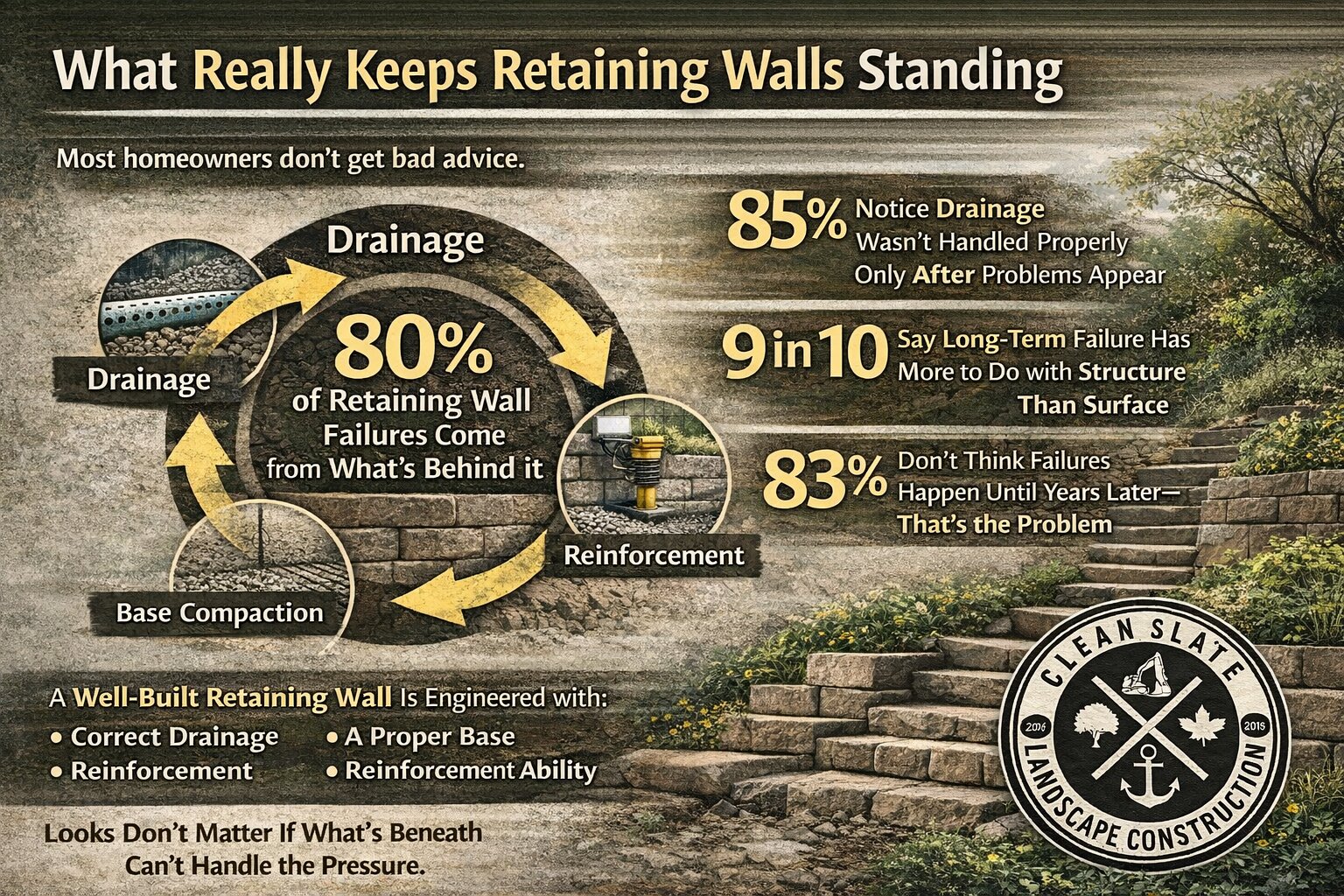
The One Factor That Decides Everything: Water
If there’s one thing that separates a wall that lasts from one that fails, it’s this:
Water management.
Not visible. Not exciting. But absolutely critical.
When water builds up behind a retaining wall, it creates pressure—more than most people expect.
That pressure:
- Pushes against the structure
- Saturates and weakens soil
- Increases weight dramatically
Without proper drainage, even the strongest materials can fail.
This is where many projects go wrong.
Because drainage isn’t what sells the job. But it’s what makes it last.
What Contractors Don’t Always Emphasize (But You Should Ask)
Not every contractor skips details intentionally.
Sometimes it’s about speed. Sometimes about simplifying the conversation.
But these are the questions that matter:
- How is water being managed behind the wall?
- What kind of base preparation is included?
- Is reinforcement needed for this height and soil type?
- What happens if pressure builds over time?
If those answers aren’t clear, the project isn’t complete—no matter how confident it sounds.
What “Built to Last” Actually Includes
A retaining wall that holds up over time isn’t just about what you see.
It’s about what’s built underneath and behind it.
That includes:
Proper Excavation
Removing unstable soil and preparing a solid foundation.
Compacted Base Layer
Creating a stable platform that won’t shift under load.
Drainage System
Gravel backfill, perforated pipes, and outlets to relieve water pressure.
Reinforcement
Geogrid or structural support when needed.
Thoughtful Material Use
Choosing block or stone based on actual site conditions—not just preference.
When all of this is done right, the wall doesn’t just stand—it performs.
The Cost of Getting It Wrong (That No One Talks About)
A failing retaining wall doesn’t just mean rebuilding the wall.
It often means:
- Replacing lost soil
- Fixing drainage issues
- Repairing nearby structures
- Paying for removal and reconstruction
That’s why the “cheaper option” upfront can become the more expensive one later.
And it’s why so many homeowners say:
“I wish we had just done it right the first time.”
The Shift From Guessing to Knowing
There’s a moment where this stops feeling like a confusing decision—and starts feeling clear.
Not because the options changed.
But because you understand what actually matters.
You stop asking:
“What looks better?”
And start asking:
“What holds up?”
That shift changes everything.
FAQ: What You Should Know Before You Decide
How do I choose between block and natural stone?
It depends on your yard’s conditions and your goals. Block offers engineered consistency, while stone offers natural durability—but both require proper installation to last.
Is one option more durable than the other?
Not inherently. Durability comes down to how well the wall is built, especially the base and drainage system behind it.
Why do retaining walls fail?
Most failures come from poor drainage, weak foundations, or lack of reinforcement—not the material itself.
Can a poorly built wall be fixed?
Sometimes—but often it’s more cost-effective to rebuild it properly than to patch ongoing issues.
How long should a retaining wall last?
A well-built retaining wall can last decades. A poorly built one may show issues within a few years.
Is drainage really that important?
Yes. It’s one of the most critical parts of the entire structure. Without it, pressure builds and failure becomes likely.
What should I look for in a contractor?
Someone who talks about structure, drainage, and long-term performance—not just materials and price.
You’re Closer to the Right Decision Than You Think
If you’ve made it this far, you’re not guessing anymore.
You’re asking better questions. Seeing the bigger picture.
And that’s exactly how you avoid becoming the homeowner who has to redo everything later.
Ready to Build Something You Don’t Have to Worry About?
You don’t have to settle for “good enough.”
You can build something that actually holds—through storms, seasons, and time.
Call 888-912-6706 or explore your options for retaining wall construction to learn more about our Retaining Wall Construction services in Cape Cod.